 Julian Eiers
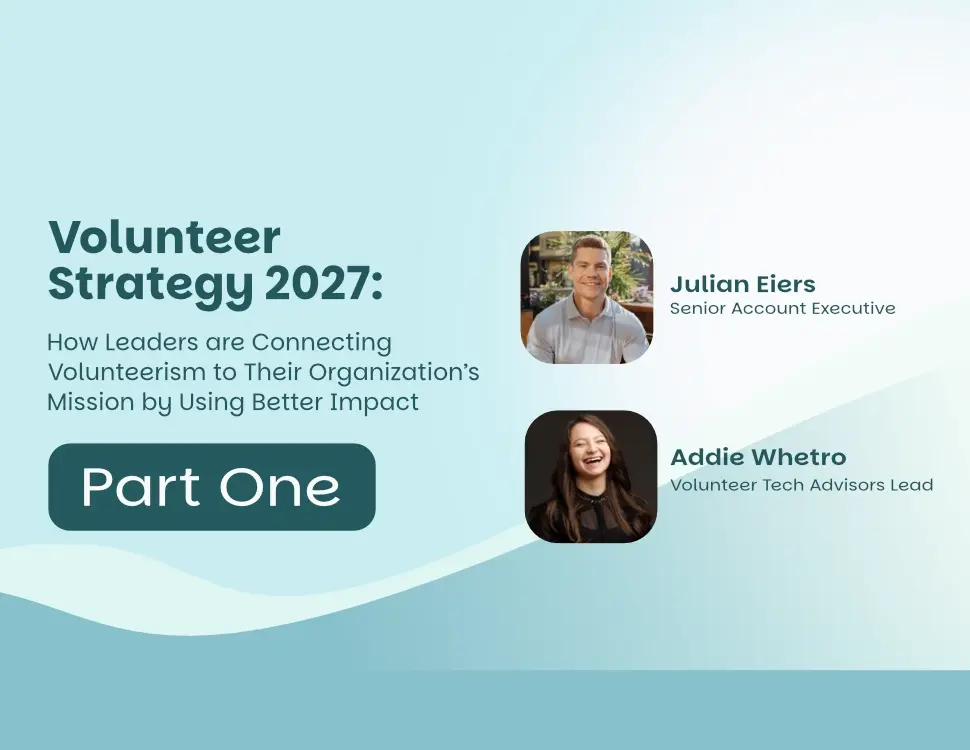
Your volunteers already believe in your mission enough to give their time. Many of them give financially too. In Part 1 of our Volunteer Strategy 2027 series, Addie Whetro and Julian Eiers from Better Impact explored the connection between volunteering and giving. They also showed how a smoother path from first application to long-term engagement can grow both your volunteer program and your donor base.
Part 1 recording
Recorded live on Wednesday, November 4, 2026. Running time: about 29 minutes, including audience Q&A.
Session materials
Download the resources
Access the slides from this session.
Part 1 Session Slides
PPTX · Presentation slides · Addie Whetro & Julian Eiers
Volunteer Management Software Buyer's Guide 2026
Guide · Better Impact
2-part series
Volunteer Strategy 2027
How leaders are connecting volunteerism to their organization's mission by using Better Impact.
Part 1: The volunteer-to-donor connection
November 4, 2026 · Watching now
Part 2: Register to join live
Tuesday, December 8, 2026 · 1:00 to 1:30 pm EST
In this post
Part 1
Key takeaways
- Volunteers and donors overlap more than most org charts suggest: 79% of volunteers also donate to the organizations they serve.
- Every extra step between "I'm interested" and "I'm signed up" costs you volunteers, and potential donors.
- Recognition tied to real milestones, plus regular updates on your impact, keeps volunteers engaged.
- Saved searches for your most and least engaged volunteers give you ready-made lists for recognition, re-engagement, and donor campaigns.
Your volunteers are already donors
Volunteering and fundraising usually live in separate departments. But as Addie explained, the people involved in each often overlap, and the connection runs in both directions.
79%
of volunteers also donate to the organizations they serve
69%
of high-net-worth donors also volunteer as a way to create impact
50%
of volunteers say they'll give more after volunteering
Addie has seen this firsthand. After volunteering often with one organization, she fell in love with its mission and wanted to support it financially as well.
"Not only did I want to give my time, but I really wanted to give my finances."
Addie Whetro, Better Impact
The takeaway is simple. Every volunteer you recruit and keep engaged also grows your future donor base. Organizations are acting on this by building targeted recruitment and encouragement campaigns that move volunteers along that path.
The first yes: make applying effortless
Julian framed recruitment and engagement as two "yeses." The first is when someone decides to apply. The second is when they keep coming back. To show both, he walked through the experience of John, a would-be volunteer who has meant to sign up for a while and finally feels motivated after spotting a post online.
John lands on the organization's website. The volunteer page is branded, written in plain language, explains the mission, and shows the opportunities available. This is the moment he's most likely to act.
Any friction here costs you. Julian pointed to a few common culprits:
- Emailing to express interest, then waiting days or weeks for a reply
- Having to phone in
- Printing, scanning, and uploading paperwork
Faced with steps like these, many people decide to do it later and never get around to it, or they volunteer somewhere that makes it easier.
With an online application workflow, John clicks "Apply to Volunteer," creates a login with his email address and a password, and completes your application form. Your organization builds that form, so you collect as much or as little information as you need. John finishes his part in minutes, and his details are in your system right away.
The second yes: keep volunteers coming back
A few weeks later, John has completed his orientation and a couple of shifts. That doesn't mean he's with you for good. Julian shared federal data showing that 1 in 3 volunteers stop volunteering after their first year. He offered two ways to improve those odds.
Make signing up for shifts easy
In the volunteer portal, available online and through the mobile app, John opens the opportunity calendar and sees the shifts that match his qualifications, interests, and abilities. Signing up takes about three clicks. The shift then appears on his schedule, he gets reminders so he shows up, and he can track his hours afterward.
Seeing everything that's available can also spark interest in something new. Julian noted that volunteers often stick to the same role at the same location, and simply showing them other options can lead to more sign-ups.
Have volunteers who would rather not use the portal? Your team can sign them up from the admin side.
Recognize real milestones
Because you can see each volunteer's hours, activities, and roles, you can set milestones and recognize people when they reach them. Think five years of service, 200 hours, or a new certification. Badges, awards, and personal emails all work. What matters is that your thanks is tied to specific work, not a generic "great job."
"Those who feel seen and valued stay. And those who stay ultimately end up donating more."
Julian Eiers, Better Impact
Show the impact of their work
The portal is also a place to share photos, personal messages, accomplishments, upcoming events, and progress toward your goals. This helps volunteers see how their work contributes to the bigger picture. It matters for giving too: people are much more likely to donate when they can see proof that the work is succeeding, and seeing that each time they log in keeps it front of mind.
Behind the scenes: fast follow-up and smarter outreach
A smooth volunteer experience only works if the admin side is quick and easy too. Julian showed how leaders of volunteers manage it in Better Impact.
See new applicants first thing
Your admin dashboard shows your recruitment pipeline at a glance: accepted volunteers, applicants in process, and new applications. If John applied last night, he's in your applicant list when you log in the next morning, with all his answers ready to review. Once you decide he's a good fit, you update his status to accepted and he receives your welcome follow-ups. No digging through inboxes, and no applications slipping through the cracks.
Save searches for your most and least engaged volunteers
Saved searches keep two important groups in view:
- Your most engaged volunteers, such as everyone with more than 100 hours. Recognize them for their work, and remember they're likely your warmest audience for donation asks and encouragement campaigns.
- Volunteers who've drifted away, such as anyone with no hours in the last six months. Often they had a good reason for stepping back, and a warm "we miss you" message can bring them back.
"It's a lot easier to get one of these volunteers back into your program than to go and recruit a new volunteer who's never heard of you."
Julian Eiers, Better Impact
Use reports to spot patterns
Pre-built reports show hours by category, by activity, or by individual volunteer for any time frame you choose. They help you see who's contributing most and who might be encouraged to get more involved. They're also handy when you need numbers for a grant application.
Send targeted, personal messages
Many organizations try to keep up with volunteers through spreadsheets, text messages, and personal email accounts. With Better Impact, you can email or text volunteers directly. Message everyone, or filter by criteria like qualifications, hours logged, or availability. For example, you could reach everyone qualified for a shift this weekend, or thank everyone who has logged 100 hours. Addie noted the same filters can support targeted donor campaigns as well.
Consistent, personal communication keeps volunteers engaged. But as Julian pointed out, it has to be easy for your team, or it won't happen.
Never miss a birthday or anniversary
Built-in birthday and service anniversary reminders help you mark the moments that are easy to forget without a good system.
Try this
Three saved searches to set up this week
- Top contributors: volunteers with more than 100 hours, or whatever milestone fits your program
- Lapsed volunteers: anyone with no hours in the last six months
- Light but steady volunteers: people who show up regularly but only occasionally, such as once a month, who might welcome an invitation to do more
Your questions, answered
Can recognition badges be automated?
Not fully. Badges don't appear on a volunteer's portal automatically, but you can run reports and set reminders for when volunteers reach certain milestones. Everything is ready for you, and presenting the recognition takes just a click.
How do volunteers opt in to shift reminders?
Volunteers can subscribe to weekly reminder emails from their schedule in the portal. Others may prefer to add shifts to their own calendar, such as Google Calendar, so they can choose what works for them.
How long does it take to set up?
It depends on the size of your organization. A basic volunteer portal that accepts online applications can be in place in under a week. Getting your full system ramped up and your whole team trained usually takes at least a month. You don't have to do everything at once, so you can stage your setup around what you need most right now.
Does it work with our existing website?
Yes. Most organizations add a "Volunteer Now" or "Apply Now" button to their website that links to their Better Impact login and application page. There's no need to rebuild your site.
Can I report on volunteers who serve regularly but only occasionally?
Yes. You can build custom reports, and many needs are already covered by built-in reports. For example, a report on hours by individual volunteer for a selected time frame shows who's contributing a lot and who's contributing a little, so you can follow up with people who might be ready to do more.
Coming up in Part 2
The Volunteer Strategy 2027 series continues on Tuesday, December 8, 2026, from 1:00 to 1:30 pm EST. Register for Part 2 to join live. We'll send the recording to all registrants regardless of attendance.
Season of Giving Offer
This Season of Giving, get two months free
Sign an annual contract by December 31, 2026 and get two months free, a 16% savings on your first year.
Join 85,000+ organizations using Better Impact to schedule, track hours and communicate with volunteers.
Season of Giving
2 months
free
16% savings on your first year
Sign an annual contract by December 31, 2026
Keep learning
Want help applying these ideas to your program? Our Volunteer Tech Advisors offer tech audits that look at your specific recruitment and engagement challenges and how technology can help. Get in touch to book a conversation.
- See how the Better Impact volunteer portal works
- Browse more sessions in the Better Impact Webinar Library
Meet the presenters

Addie Whetro, Better Impact
Addie Whetro is the Leader of the Volunteer Tech Advisors team at Better Impact, where she helps organizations find the right technology for their volunteer programs. After a couple of years as a Volunteer Tech Advisor, she has talked with hundreds of volunteer leaders and learned what helps their programs succeed. She brings a background in aging-in-place technology, a deep care for seniors, and an archaeologist's curiosity to every conversation. Today she leads a team that helps volunteer leaders spend less time on admin and more time on their mission.

Julian Eiers, Better Impact
Julian Eiers is a Senior Account Executive at Better Impact, where he works with organizations to find the right tools to support and grow their volunteer programs. He brings nearly nine years of experience in software, helping teams adopt technology that makes their work easier. Julian is also a longtime volunteer who has used Better Impact from the volunteer's side for years, giving him a firsthand view of what makes the experience work. His focus is on helping leaders of volunteers create onboarding, communication, and engagement that keep people coming back.
Featured Posts
- Mastering Volunteer Management: The Ultimate Nonprofit Guide
- 18 Best Volunteer Management Software Tools for Nonprofits
- Nonprofit Volunteer Recruitment: Overview + Top Strategies
- Volunteer Training: How to Set Volunteers up for Success
- Volunteer Appreciation: Getting Started + 10 Top Ideas