
For state Medicaid and benefits programs
Verified Volunteerism Hours for Streamlining Benefit Program Work Requirements
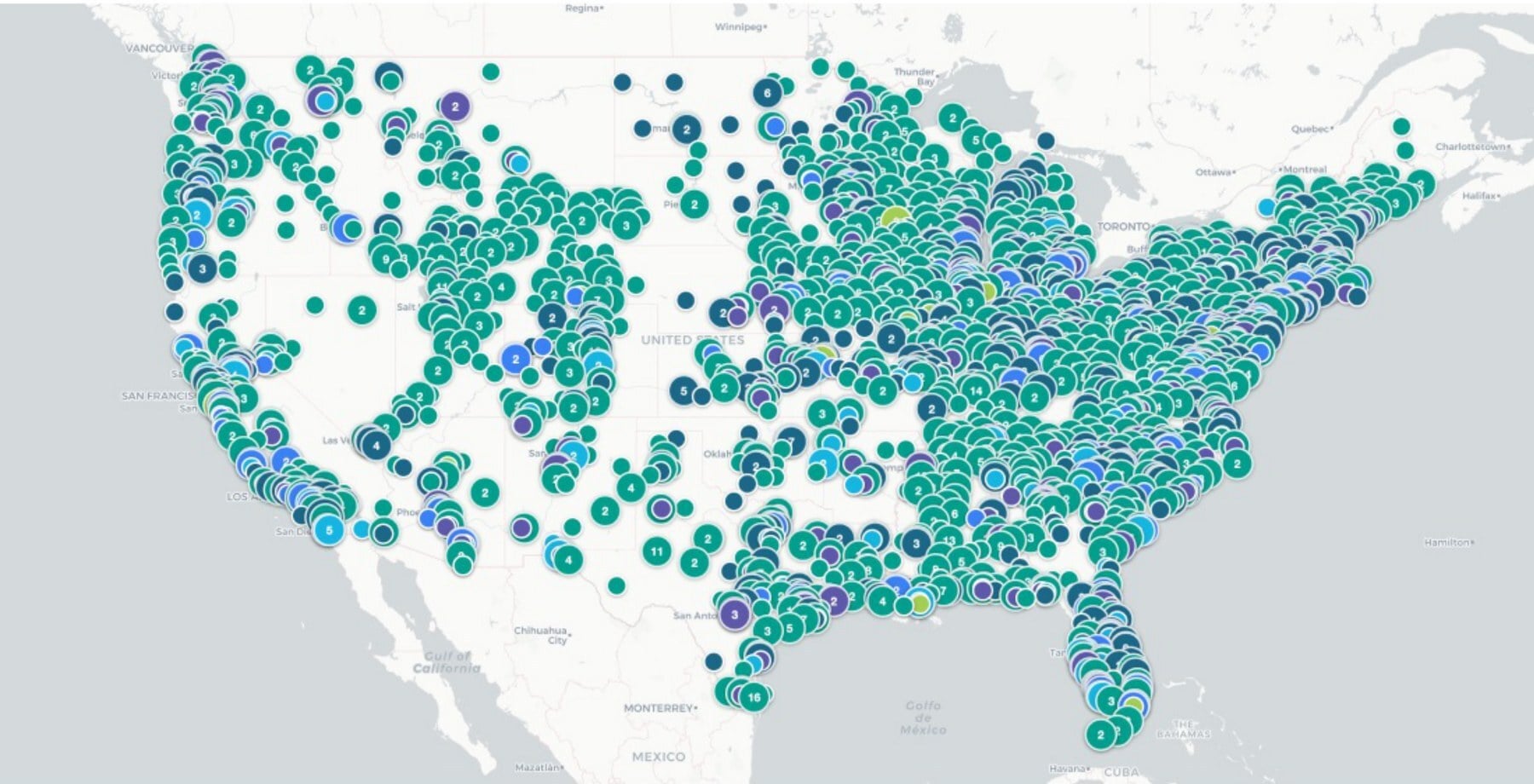
When community service counts toward a work requirement, states need a reliable way to verify the hours completed. CE Hours gives states access to coordinator-validated volunteer-hour records from our network of 65,000+ organizations, while eligibility decisions remain fully in the state's control.
- 65,000+ volunteering organizations
- Coverage across all 50 states
- Coordinator-validated hour records
- Consent-based data sharing
Better Impact provides verified hour data. Your agency determines eligibility.
See how it worksThe volunteerism and Medicaid ecosystem
The bridge between community engagement and Medicaid and government programs
State volunteerism teams create access to opportunities, Better Impact powers the volunteer experience, CE Hours turns that activity into verified hour data, and your eligibility systems put it to work.
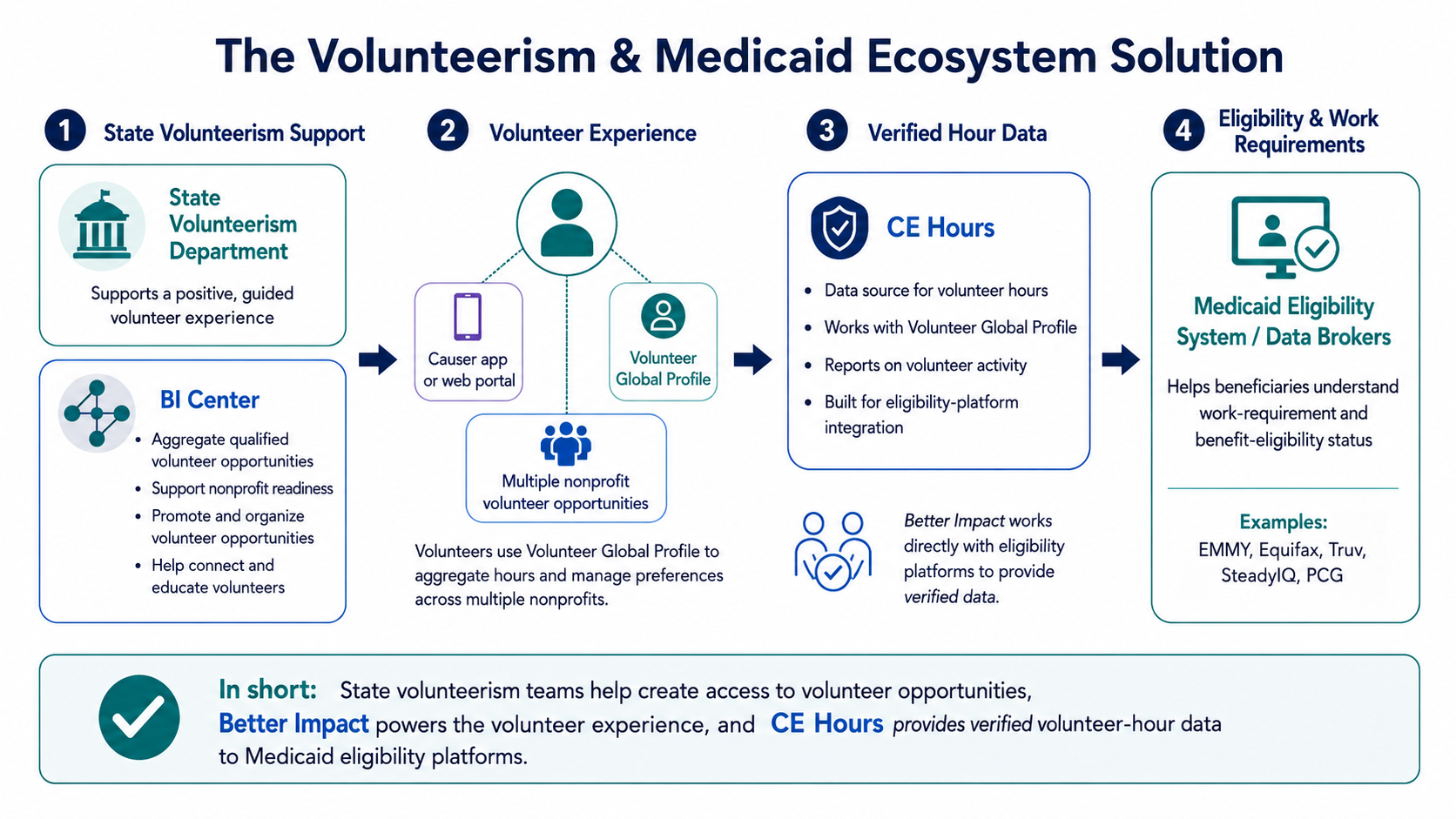
In short: State volunteerism teams help create access to volunteer opportunities, Better Impact powers the volunteer experience, and CE Hours provides verified volunteer-hour data to Medicaid eligibility platforms.
Why this matters
Community service can help people meet work requirements
Federal community engagement requirements require certain Medicaid expansion enrollees to complete 80 hours a month of work, education or training, or community service. The requirements apply to non-exempt adults in the Medicaid expansion population, and states must verify participation at application and at each six-month renewal. For Medicaid, states must implement community engagement requirements by January 1, 2027. SNAP work requirements are already in effect following changes enacted July 2025.
For enrollees who do not meet the full 80-hour requirement through work or education alone, verified community service hours can fill the gap. When someone completes that service, the state needs a reliable way to see it. Reliable verification data reduces manual paperwork for caseworkers, helps prevent avoidable coverage loss from administrative burden, and supports program integrity.
Sources: USDA, SNAP Work Requirements and CMS, Medicaid Community Engagement Requirement (Interim Final Rule).
See how the 80 hours add up
Most people meet the monthly requirement through work or school. Community service can fill whatever is left. Move the sliders to see how the pieces combine.
This is an educational illustration only. It is not an eligibility calculator. Program rules, exemptions, qualifying activities, and verification requirements vary by state and program.
-
Federal law establishes work requirements that count community service.
-
SNAP requirements roll out across states.
-
Medicaid community engagement requirements take effect for many expansion adults.
The platform
Meet Get Connected Center
Get Connected Center is the platform that state volunteerism commissions, United Ways, and nonprofit networks already use to post opportunities, coordinate volunteers, and record hours served. It coordinates a validated network of approved organizations, so opportunities are vetted, organizations are known, and hours are logged where the work actually happens. Every hour is tied to a person, an organization, and a date, and confirmed by the volunteer coordinator who oversaw the work.
A curated nonprofit network
Real organizations offering real, approved opportunities, coordinated under one Center with clear roles for state administrators, agency coordinators, and volunteers.
Coordinator-validated hours
Confirmed by the person who supervised the service, not left to self-reporting alone.
One profile, every organization
A person's hours follow them across nonprofits through their Volunteer Global Profile.
Screening and onboarding built in
Background checks, training, and e-signed waivers can be required before anyone serves, and each step is tracked on the volunteer's record.
Scheduling and reminders
Coordinate shifts, schedule volunteers, and send targeted email or in-app reminders so people show up and finish their hours.
Reporting and exports for your team
Live reports, overnight data explorers, and filtered exports give your team and partner organizations a clear view of participation and hours.
How it works
How verified hours reach your eligibility system
You do not need to build a new system or run a volunteer program yourself. The hours are already being recorded. When you are ready, a secure connection delivers verified totals to your eligibility system.
What "verified" means here: the hour was submitted through the platform and confirmed by an authorized organization coordinator, with timestamps and a traceable audit trail.
POST /v1/ce-hours/verify
{
  "subject_id": "STATE-REF-000123",
  "date_range": { "from": "2027-01-01", "to": "2027-01-31" }
}
{
"verified_hours": 22,
"date_range": { "from": "2027-01-01", "to": "2027-01-31" },
"audit_trail": [
{ "org": "Community Food Network", "hours": 14, "validated_by": "coordinator" },
{ "org": "City Library Friends", "hours": 8, "validated_by": "coordinator" }
]
}{
"match": "none",
"verified_hours": 0,
"date_range": { "from": "2027-01-01", "to": "2027-01-31" },
"note": "No verified community-service record found for the submitted identifier and date range."
}Illustrative example. Integration scope is defined with your eligibility vendor.
A "no record found" response does not mean a person failed a requirement. It only means we do not have verified community-service hours matching the identifier and date range submitted. Your agency decides what that means for a case.
CE Hours is designed as the verification layer for approved state and eligibility-system integrations. The integration scope, data fields, matching logic, and delivery method are defined with each agency and vendor.
It works the way your systems already verify employment and education: a trusted third-party data source, queried on demand. For volunteer hours, that data source has not existed at scale. Now it does.
Built for real implementation
Built for the full community-service verification ecosystem
When community service is a qualifying activity, verification depends on more than one system. States need reliable data. Nonprofits need practical volunteer management tools. Residents need accessible opportunities. Coordinators need a simple way to validate hours. Better Impact connects those pieces through a product suite already built around volunteer engagement, hour tracking, reporting, and community-scale coordination.
Build the opportunity network
Who uses it: State volunteerism offices, 211 networks, United Ways, volunteer centers, cities, and community foundations.
Get Connected Center helps coordinate the supply side of community service: approved organizations, public opportunities, location-based listings, group sign-ups, events, and high-volume volunteer participation.
Why it matters: States need legitimate, accessible opportunities before they can rely on community service as a practical pathway.
Manage nonprofit participation
Who uses it: Nonprofits, healthcare organizations, shelters, food banks, libraries, parks programs, and community agencies.
Volunteer Impact gives participating organizations tools for applications, onboarding, scheduling, qualifications, training, communications, hour logging, and reporting.
Why it matters: The verification model only works if nonprofits can manage service activity without creating more paperwork.
Help residents find and complete service
Who uses it: Residents and volunteers looking for qualifying service opportunities.
People can search opportunities, complete required steps, sign up for activities, and participate through a guided volunteer experience.
Why it matters: A simpler resident experience reduces friction and helps people complete qualifying service instead of getting lost in manual processes.
Capture verified hour records
Who uses it: Volunteer coordinators and program administrators.
Hour records can include activity context, date range, check-in and check-out details, coordinator review, and reporting dimensions by person, activity, program, team, group, status, and date.
Why it matters: Eligibility systems need structured evidence, not loose self-reported activity.
Deliver reporting and verification data
Who uses it: State eligibility systems, Medicaid agencies, SNAP and TANF administrators, eligibility vendors, and approved data partners.
The verification layer can return verified hour totals, date ranges, validation status, and supporting audit context to approved systems.
Why it matters: Better Impact provides verified hour data. Your agency determines eligibility.
Want to see what this could look like in your state?
We can help your team understand the volunteer infrastructure already present in your state, including organization coverage, opportunity categories, verified-hour activity, and potential implementation pathways.
Request a state readiness snapshotPilot model
How a pilot could work
A focused pilot lets your team see the data and the workflow before any statewide commitment.
- 1
Choose a scope
Select one to three counties or regions to start.
- 2
Identify partners
Confirm the approved nonprofit partners who will host community service.
- 3
Configure categories
Set the qualifying opportunity categories that should count.
- 4
Set consent and matching rules
Establish consent and identity-matching rules with you and your vendor.
- 5
Exchange verified hours
Send monthly verified-hour files or API responses to your eligibility system.
- 6
Compare the data
Compare self-reported hours against coordinator-validated hours.
- 7
Review at 90 days
Review outcomes together and decide on next steps.
Your state
See where your state stands
Before any integration, we can put together a Community Service Verification Readiness Snapshot for your state.
- Active organizations in your state
- Posted volunteer opportunities
- Counties covered
- Active volunteer profiles
- Verified hours logged
- Nonprofit categories available for community-service placement
Frequently asked questions
Quick answers to the questions state teams ask most. A state-specific Readiness Snapshot fills in the numbers.
We provide a state-specific count in your Readiness Snapshot. The network spans 65,000+ volunteering organizations across all 50 states, and the snapshot breaks that down to the organizations, counties, and opportunity categories active in your state.
The Readiness Snapshot maps active organizations and posted opportunities by county, so you can see where volunteer infrastructure already exists before scoping a pilot.
Opportunities span the nonprofit categories active in your state, such as food assistance, libraries, parks, healthcare and hospice, and senior and disability services. The snapshot lists the categories available for community-service placement.
Coordinator-validated hours are logged across the network today. The snapshot reports the verified-hour volume in your state, so you can gauge existing activity before any integration.
With volunteer consent, a verified hour record can include the volunteer and organization identifiers, the opportunity or program, dates and hours served, submission method, coordinator validation status and timestamp, and an exportable audit trail.
A focused pilot scopes one to three counties, confirms approved nonprofit partners, configures qualifying opportunity categories, sets consent and identity-matching rules with you and your vendor, exchanges monthly verified-hour files or API responses, and reviews outcomes at 90 days.
Integration scope is defined with your eligibility system and its vendor. CE Hours delivers verified hour data to approved state and eligibility-system integrations and data partners, for example eligibility platforms and data brokers such as EMMY, Equifax, Truv, SteadyIQ, and PCG.
Request a Community Service Verification Readiness Snapshot for your state.
Want a first look at the network? See coordinator-validated volunteering locations across all 50 states.
Download the National Volunteer Network map