


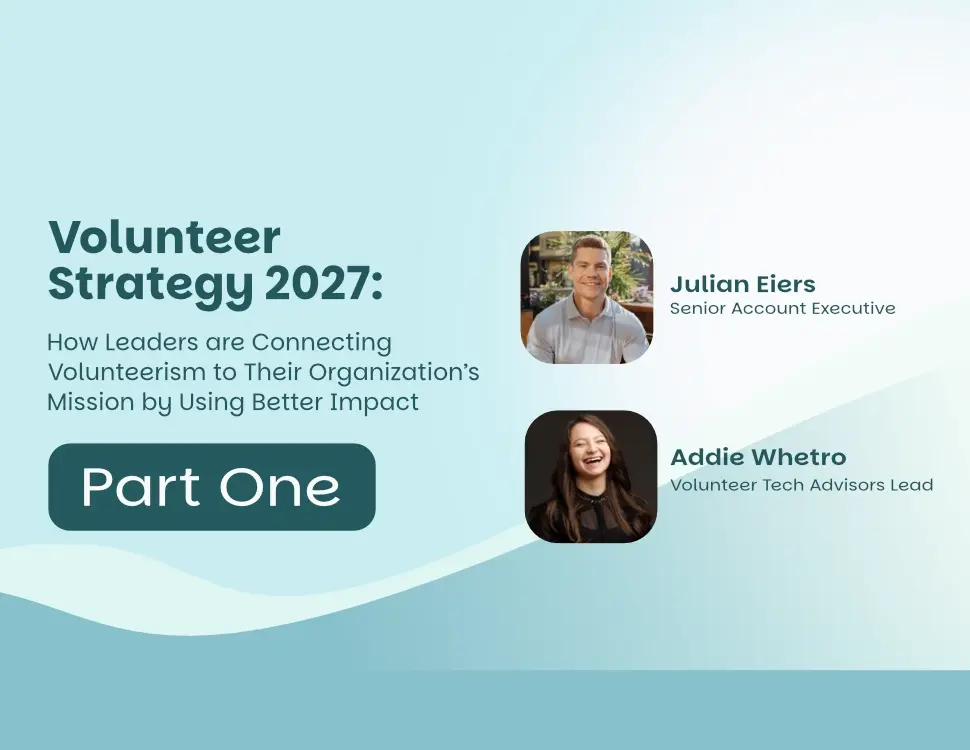
Volunteer Strategy 2027: Connecting Volunteers, Donors, and Your Mission
Your volunteers already believe in your mission enough to give their time. Many of them give financially too. In Part 1 of our Volunteer Strategy...
9 min read
Julian Eiers
Nov 23, 2026, 11:41:34 AM
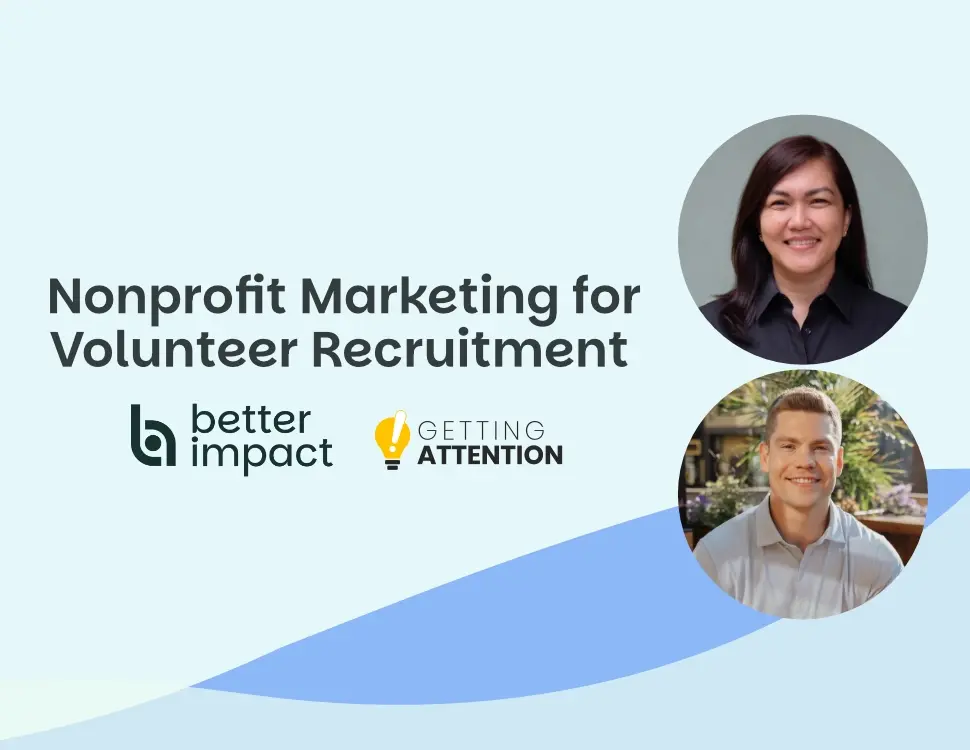
Promoting your volunteer opportunities is only half the job. In this session, Malou de Gracia of Getting Attention and Julian Eiers of Better Impact showed how to attract the right volunteers, make it easy for them to say yes, and turn that first click into someone who keeps coming back.
Recorded live on Wednesday, November 18, 2026. Running time: about 56 minutes, including audience Q&A.
PDU credit
Complete the form to receive your Certificate of Completion, which can be used towards earning Professional Development Units (PDUs).
Session materials
Access the slides and live chat from this session, plus the research Julian referenced on what helps volunteer programs grow.
Session Slides
PPTX · Presentation slides · Malou de Gracia & Julian Eiers
Live Chat Transcript
TXT · Recording chat from the session
Special Report: State of Volunteer Growth in 2026
Report · Better Impact
Malou framed volunteer recruitment in three stages: attract the right people, explain what the opportunity involves and why it matters, and engage them by making the next step easy. Before any of that, get clear on what you need volunteers to accomplish.
Take an animal shelter that wants more animals adopted. More adoption events might help, which creates specific volunteer tasks: preparing materials, setting up, welcoming visitors, and introducing adopters to animals. From there, decide whether the need is a one-day event or ongoing, and ask program staff where volunteer support would help most.
Next, build a simple profile of the volunteer you want. If the shelter needs Saturday morning help, volunteers must be able to get there and commit to an occasional recurring shift. Previous shelter experience may not be necessary if training is provided. Separating what's truly required from what's nice to have keeps you from discouraging great candidates.
Motivation matters too. Some people want hands-on experience with animals, while others simply want to support a cause they care about. Instead of a generic "volunteers needed" message, highlight what fits: Saturday shifts, training provided, hands-on experience. Ask current volunteers what drew them in, and consider who you might be missing.
Recruitment marketing works in two directions. Outbound is outreach you start, like email, social media, partnerships, and word of mouth. Inbound is when people find you on their own through Google, volunteer directories, AI tools, or your website. The strongest programs use both.
A volunteer's quick video or personal story often grabs more attention than a polished graphic. Before adding another channel, check where your current volunteers actually came from, then focus on the channels that bring in good fits and that your team can realistically maintain.
For people already searching, a few fundamentals help:
All three depend on your website. A page that says "We always welcome volunteers, contact us to learn more" gives search engines and people very little to work with. A page that describes specific roles, schedules, locations, and requirements gives them what they need.
Through the Google Ad Grant, eligible nonprofits can receive up to $10,000 a month in Google search advertising credit. It isn't cash, but it lets you run search ads for volunteer opportunities, programs, and resources, with control over which searches you target, what your ads say, and where people land.
Malou shared an example from All for Paws Animal Rescue. A search for volunteering at an animal shelter nearby showed their sponsored ad, with links to volunteer and foster. In the second quarter of 2026, their campaigns generated 235 volunteer applications started and 23 volunteer resource downloads.
The advantage is intent. Unlike social media, where you're interrupting someone's scroll, people searching on Google are already looking for a way to help. Results depend on strategy: targeting relevant searches, matching ads to what people want, and improving campaigns over time.
Once someone reaches your website, explain two things clearly:
If you have several roles, give each one its own page or a well-organized section so people can quickly find the right fit.
Then engage by making the next step easy. Dogs on Deployment, which connects military members with volunteer pet caregivers, runs a search ad for virtual volunteering that leads to a page about exactly that. It explains the roles and time commitments, puts a sign-up button near the top, notes that no military background is needed, and offers help finding the right role.
Wherever people come from, ask yourself: Are you sending them somewhere relevant? Is the next step obvious? How many steps and form fields stand between them and signing up? Test it on mobile. Remember, too, that not everyone is ready to apply right away. Options like browsing openings or attending a virtual info session can give people the confidence to apply later.
When sign-ups fall short, look at each stage before adding more promotion:
You don't need complex analytics. Find the likely sticking point, make one improvement, and see if it helps.
Julian picked up from there. More Americans are volunteering, with 28.3% formally volunteering in 2023, up from 23.2% in 2021. But each volunteer is giving fewer hours. Nearly half of nonprofit CEOs still call recruitment a major challenge, and often the problem isn't getting people to apply but what happens next.
Julian compared it to filling a bucket with holes. A great campaign can bring in plenty of applications, but if nobody watches the inbox, they sit for weeks and the interest fades. The first five minutes and first five days after someone applies are crucial:
Every day between approval and a first shift is another chance for someone to drop off. To keep people moving:
Julian shared research from a 2024 survey of about 2,400 volunteers on why they left or considered leaving. Most of the reasons are within an organization's control. Two stand out for new volunteers: feeling left out, and poor communication.
Better Impact's State of Volunteer Growth research, which followed about 4,000 volunteer programs for a year, found that growing programs succeed across sectors because they measure where they're performing and where they need to improve. Start with these four numbers:
The second-shift rate shows whether your experience is working. Returning volunteers are also your best recruiters, so build a simple feedback question into your workflow, such as "What stood out to you as impactful lately?" Over time, you'll build a library of genuine stories for your website and social media.
As Julian put it, marketing and the volunteer experience aren't separate. Great marketing with a poor experience leads to drop-off, while a great experience with poor marketing goes unnoticed.
None of these require a budget or new tools:
In the U.S., you need to be a 501(c)(3) nonprofit, and your website must meet Google's requirements. A compliance suspension usually isn't permanent. You can often fix the issue and request reinstatement. Watch for overly broad or single-word keywords and low quality scores. Most requirements exist to help you get better results, and Getting Attention hosts free Google Ad Grant webinars twice a week.
Add two backup emails to both your Google Ad Grant and Google for Nonprofits accounts, ideally including a shared general address. If access is lost, you'll need to work with Google to reinstate the account, which takes time but is usually possible.
If you don't need those steps, don't add them. A shorter path to a first shift is better. Just make sure you capture contact details so you can invite people to engage more deeply over time. Email capture through the Ad Grant can help with this too.
There's no exact number. Follow up more often in the first few weeks, ease off over the first couple of months, then move people into a nurture sequence that shares your work and welcomes them back anytime. Attendees suggested approaches such as three attempts before marking someone inactive. Not everyone who applies will convert, so learn what a healthy completion rate looks like for your program.
Ask what roles interest them and why they want to volunteer during intake, then use their answers to send personalized nurture emails once or twice a month. Add an occasional phone call to share your excitement and answer questions.
Malou de Gracia is the Nonprofit Education Specialist at Getting Attention, where she helps nonprofits strengthen their digital marketing and make better use of the Google Ad Grant. With more than seven years of experience in marketing and technology, she has worked across nonprofit education, digital strategy, and search marketing. Her work focuses on turning digital marketing concepts into practical strategies nonprofits can use to reach new audiences, increase visibility, and inspire people to take action.
Julian Eiers is a Senior Account Executive at Better Impact, where he works with organizations to find the right tools to support and grow their volunteer programs. He brings nearly nine years of experience in software, helping teams adopt technology that makes their work easier. Julian is also a longtime volunteer who has used Better Impact from the volunteer's side for years, giving him a firsthand view of what makes the experience work. His focus is on helping leaders of volunteers create onboarding, communication, and engagement that keep people coming back.
See how Better Impact helps you respond faster, automate onboarding, and track the numbers that matter. Sign up by December 31, 2026 and get two months free on your first annual subscription.
Book a demoFeatured Posts
Your volunteers already believe in your mission enough to give their time. Many of them give financially too. In Part 1 of our Volunteer Strategy...
Most people don't set out to become volunteer leaders. They inherit a spreadsheet, a binder, and a long list of responsibilities, then figure it out...
Many leaders of volunteers know they need better tools, but cost, time, and worries about tech-shy volunteers hold them back. In this session, Didier...