3 min read
More time for H.R.1 Medicaid. Here’s how to use it.
 Timothy Sarazen
Nov 23, 2026, 7:00:03 AM
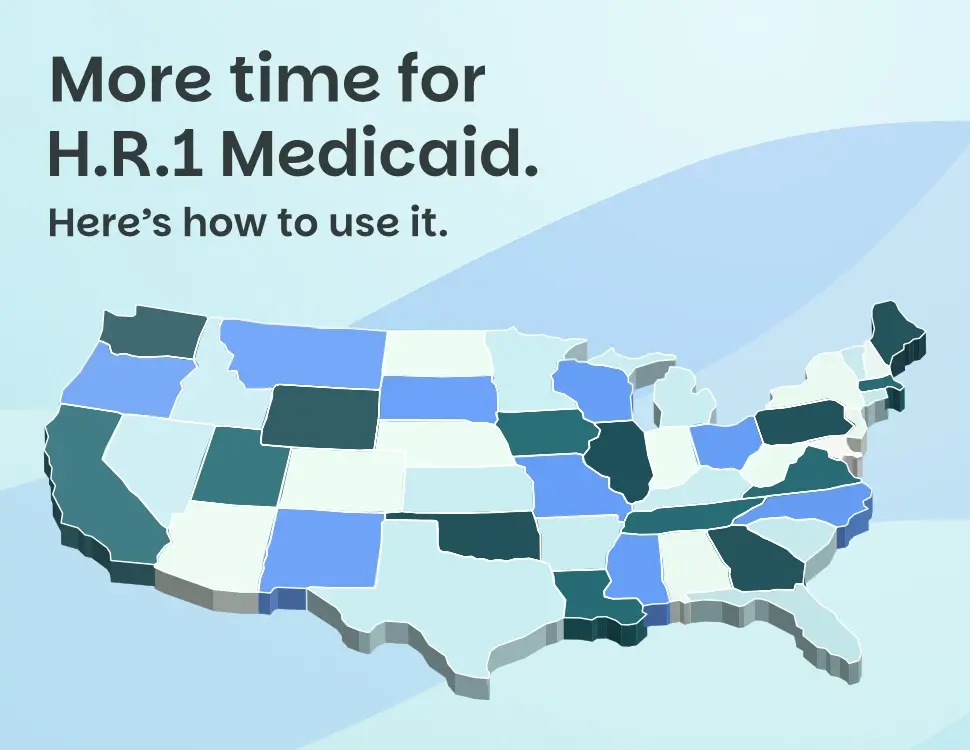
For our U.S. community: this update covers new federal guidance on H.R.1, which applies to U.S. states, volunteer centers and nonprofits.
Earlier this month, the Centers for Medicare & Medicaid Services (CMS), the federal agency that oversees Medicaid, gave states something many had been asking for: more time. In a new letter to state Medicaid directors (SMD #26-006, November 13), CMS is offering an optional “hold harmless” period through June 30, 2027.
It’s welcome news for state teams working hard toward the initial January implementation date, and here’s where things stand right now.
What the guidance does
- States can pause denials and disenrollments tied to community engagement: If a state elects the option, it can suspend eligibility denials and disenrollments when someone hasn’t yet shown they meet the requirement, through June 30, 2027 or a shorter period the state chooses. CMS won’t take enforcement action for that.
- It’s a request, not an automatic pause: States ask for it in their mitigation plan and need CMS approval. States that want it from January 1 are asked to notify CMS by December 11.
- Early determinations won’t count against states: Decisions made during an approved hold harmless period won’t be treated as errors in federal eligibility reviews.
What it doesn’t change
- January 1, 2027 is still the implementation date: The hold harmless period only covers denials and disenrollments for community engagement.
- States still have to check: To use the option, a state must keep assessing whether people meet the requirement or qualify for an exclusion, for every relevant application and renewal.
- Other eligibility rules still apply: Income, age and other factors aren’t covered.
This builds on what we shared when we announced our program to help U.S. states respond to H.R.1 Medicaid by building on the volunteer network they already have. The new guidance makes that approach more relevant, not less.
What CMS expects from states
CMS says states should use available, reliable data and, wherever possible, automated processes to verify qualifying activities, minimizing the need for people to submit information the state can get electronically. And when more information is needed, people should get clear options, accessible help and a straightforward way to respond.
That’s the principle we’ve been advocating all along: query before you burden. CMS is now saying it plainly, and it expects states to use this extra time to build those automated data sources.
Why volunteering is where this matters most
Work and school hours have data sources states already know how to check. Volunteering is where states most frequently need to fall back on paper, and some are still relying on paper attestation forms that put the work on applicants and on the staff who review them.
It doesn’t have to work that way. Volunteer centers and nonprofits already record and verify hours every day. The hold harmless period is the right moment to connect to that data, before enforcement begins.
How we see this working
Take a fictional state, State A. When it reviews an application, its eligibility system first runs a secure query for verified volunteer hours held by participating volunteer centers, with the applicant’s consent. If the hours are there, nobody fills out a form. If they aren’t, the eligibility worker can point the applicant to a local organization that already records and verifies hours, so those hours count from the start. The hold harmless period gives State A time to test all of this before enforcement.
Making the most of the extra time
- Build automated data sources now. That’s what CMS expects states to work on during this time, and volunteer hours are a good place to start.
- Test during the hold harmless period. States using the option still assess every application and renewal, which makes it a chance to test and refine systems before enforcement.
- Make the fallback simple. Where people still need to share information, give them clear options, accessible help and a straightforward way to respond.
We’ll walk through each of these steps, and what the hold harmless period means in practice, at our Live Info Session on Tuesday, December 8th. Bring your questions about your state’s plan.
Good news for state service commissions
There’s also encouraging news on the volunteer side. Under the current proposal for this year’s $30 million Volunteer Generation Fund, $15 million would go by formula to the 52 state service commissions, with another $15 million available through competitive applications for nonprofits and other eligible organizations. If it holds, that’s real support for the networks states will rely on. Details may change, so check AmeriCorps’ Volunteer Generation Fund page for the latest.
Want to see how H.R.1 plays out where you are? CHC: Creating Healthier Communities has built an H.R.1 Public Atlas that maps its impact by state.
More time, same direction
The hold harmless period doesn’t change where states need to end up. It gives them room to get there well: automated, data-first, and without pushing the paperwork onto people or the nonprofits that serve them. Every hour counts, and now there’s a little more time to make sure each one is counted.
- Catch up: read our Every Hour Counts announcement.
- Learn more: see how verified volunteer hours can reach your state on our H.R.1 Medicaid page.
- Join us live: Every Hour Counts: A Practical H.R.1 Medicaid Briefing for States and Volunteer Centers, Tuesday, December 8, 1:00–2:00 pm ET. Register here.
- Talk with us: ready to plan how your state will use the extra time? Speak with an H.R.1 Medicaid expert.
Every state is different. Whether and how your state uses the hold harmless period is up to your state and CMS.
Featured Posts
- Mastering Volunteer Management: The Ultimate Nonprofit Guide
- 18 Best Volunteer Management Software Tools for Nonprofits
- Nonprofit Volunteer Recruitment: Overview + Top Strategies
- Volunteer Training: How to Set Volunteers up for Success
- Volunteer Appreciation: Getting Started + 10 Top Ideas