



The Consequences of Good vs. Bad Volunteer Experiences
This article originally appeared on www.mavanetwork.org and is featured here in partnership with the Minnesota Alliance for Volunteer Advancement.

9 min read
Lisa Sorbie
May 12, 2026, 2:00:00 PM
Whether you’re developing a new volunteer program or reviewing an existing project, it’s important to know what your community actually needs and the resources available to you. That’s where a community needs assessment comes in.
In this article, we’ll dive into how to conduct a community needs assessment and best practices for building your program around this assessment. Plus, we’ll share valuable resources, including examples and a free template.
Article Contents
A community needs assessment is a way of collecting data and surveying stakeholders to understand gaps in community services, as well as the strengths and assets available in your community.
Collecting community needs data will help your organization gain a deeper understanding of your community, prioritize its resources, appeal to stakeholders like your board or donors, inform new programming, and celebrate successes.
Anybody working in a service-driven organization knows that communities can experience all types of needs, even at the same time!
However, categorizing your community’s needs will help you understand those that are most pressing and important to your community:
|
Need Type |
Definition |
Community need example |
|
Perceived Needs |
Gaps in services based on what individuals feel about their own needs or the needs of the community. Organizations can learn about perceived needs by speaking directly to community members through surveys, focus groups, or town meetings. |
Community members express concerns about lack of mental health services in their area through a town hall meeting. |
|
Expressed Needs |
A perceived need becomes an expressed need when a number of individuals take similar action. Be mindful of the false assumption that all people with needs always seek help. |
A number of community families are seeking affordable local daycare services because the current services are at capacity. |
|
Normative Needs |
Needs identified based on a set of agreed-upon criteria or standards. |
A state-wide authority establishes standards for public housing; a community identifies a need for improved local public housing based on these criteria. |
|
Absolute Needs |
Universal needs deemed essential for survival. Many organizations and community leaders prioritize absolute needs over others. |
Shelter, food, water, safety, and clothing. |
|
Relative Needs |
Needs identified based on equity—when two groups or communities with similar characteristics do not receive similar services. |
Students from School A who receive free lunches reported being happier at school. The program determines that School B should also receive free lunches to improve student engagement and performance. |
A community needs assessment can help your organization:
Surveying community members and identifying needs are beneficial at any stage. Here are some of the times you may want to assess community needs:
Here are just some of the voices you can involve in your assessment:
While it’s no easy task, involving these stakeholders in your community needs assessment will help take the impact of your actions to the next level.

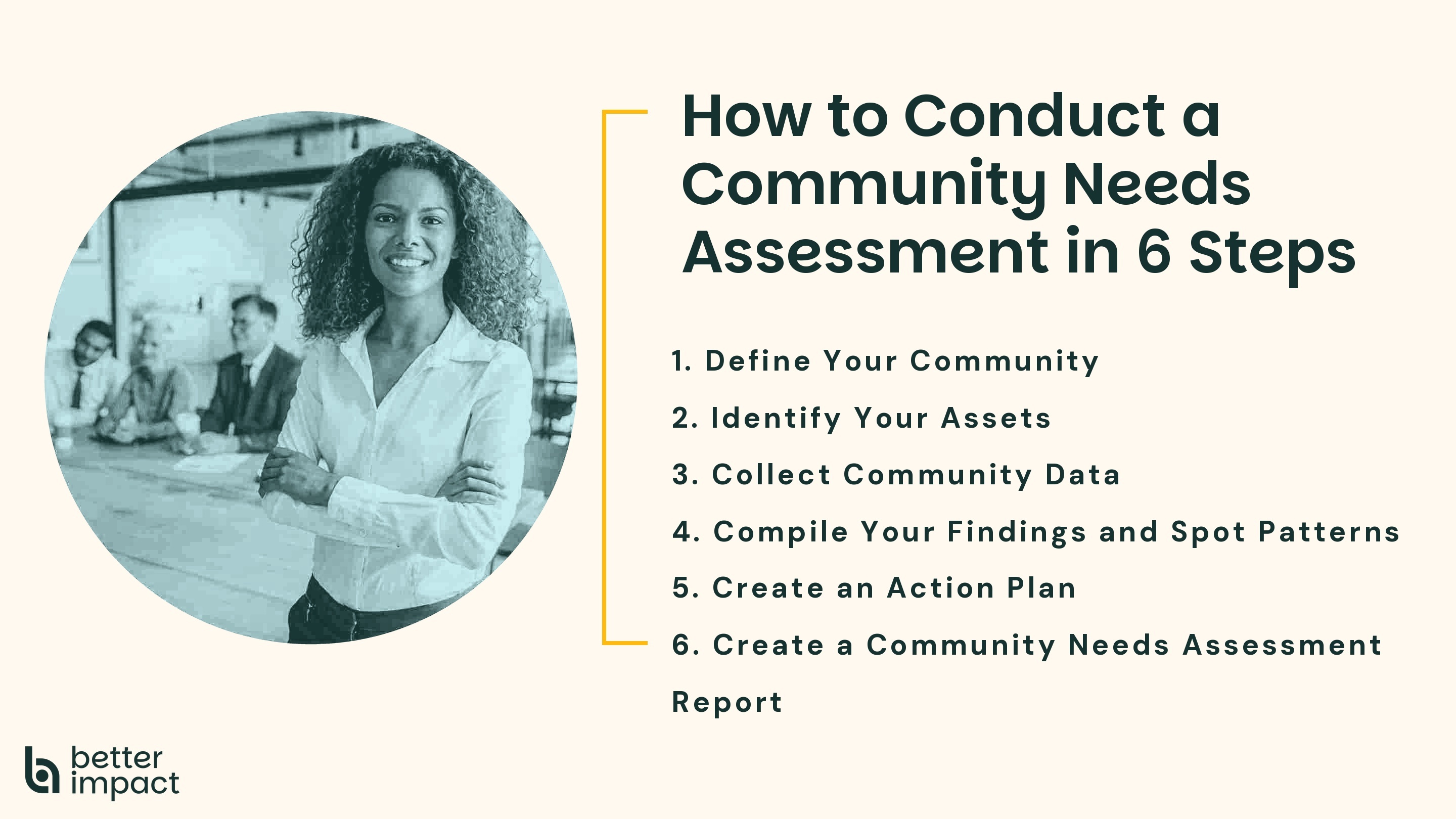
Assessing needs in your community is a systematic process that requires planning. Follow this six-step community needs assessment template to get a strong grasp of your community’s needs and strengths in no time.
The first step? Figure out the people and places that make up your community. Define your community by considering these questions:
Defining your community can help set the scope of your assessment by giving you a sense of who should be involved.
While a community needs assessment serves to identify the challenges and gaps in services within a community, it can also help you understand unutilized or underutilized resources and assets available to your organization and community. These might include:
Generally, there are three types of community needs assessment surveys:
Alternatively, you could collect data through:
Before you write your report, you’ll need to gather the data from your interviews, surveys, and observations and take a look at what trends and patterns you notice.
To help make sense of your data, you can organize it into the following categories:
Example: Your organization maintains robust community partnerships that work collaboratively to serve low-income youth.
Example: Time constraints for volunteer management staff and lack of volunteer retention strategy lead to higher turnover rates and lower return on investment.
Example: Youth programs tend to halt after graduation; there is a lack of follow-up support for low-income women above school age.
Example: Programs directed toward low-income women in similar communities experienced an increase in funding last year.
As you analyze your findings, keep in mind that certain themes may point toward different types of actions your organization can take. These actions generally fall into three categories:
|
Action Type |
Description |
Example |
|
Policy or Guidance |
Actions that influence policies, regulations, or formal guidelines to change behavior at a broad level. |
Through public records, a local nonprofit learns that 80% of the district's children under 18 are food insecure. The organization campaigns to lower the household income threshold for free school lunches. As a result, the school board enacts new policies and expands the lunch program budget. |
|
Larger System Changes |
Actions that shift social norms, institutional processes, or community-wide practices—without necessarily changing laws or policy. |
A survey reveals that 30% of low-income families aren't aware of their children's eligibility for free school lunches. A nonprofit responds with a targeted awareness campaign and supports families in applying for benefits, increasing participation across the district. |
|
Social, Economic, or Physical Changes |
Actions that modify the environment, resources, or conditions that influence behavior or well-being. |
Conversations with pediatricians reveal that many children aren't getting adequate nutrients. An after-school program launches a fundraising campaign to provide healthy snacks, addressing a physical barrier to child well-being. |
Once you’ve categorized your findings, you’re ready to translate them into concrete action. A strong action plan ensures your insights don’t sit in a report—they drive meaningful change. Here’s a step-by-step approach:
After you compile your data, you’ll want to create a report that summarizes your method, findings, and recommendations.
The report should include the following sections:
Here are some examples of what a community needs assessment should look like:
A community needs assessment is one of the most powerful tools your organization can use to understand what your community truly needs—and how to respond with programs that make a real, measurable impact. But identifying needs is only the beginning. To act on your findings, you need the right systems in place to engage volunteers, coordinate programs, and communicate with stakeholders. That’s where Get Connected can help.
With Get Connected, your team can centralize volunteer data, streamline communication, schedule volunteers efficiently, and track the impact of your programs—all in one place.
Ready to find out how Volunteer Impact can help you make more impact? Schedule a free demo today.
Featured Posts
This article originally appeared on www.mavanetwork.org and is featured here in partnership with the Minnesota Alliance for Volunteer Advancement.
Introduction In the world of volunteer engagement, dedicated individuals work tirelessly to develop impactful volunteer programs in support of their...
In the world of volunteering, recognition matters. Not just in grand gestures or formal awards, but in ways that speak personally to the individual...